The Dallas Stars Are Coming to Plano: Inside the Willow Bend Arena District — and Why It's a Game-Changer for North Texas Real Estate
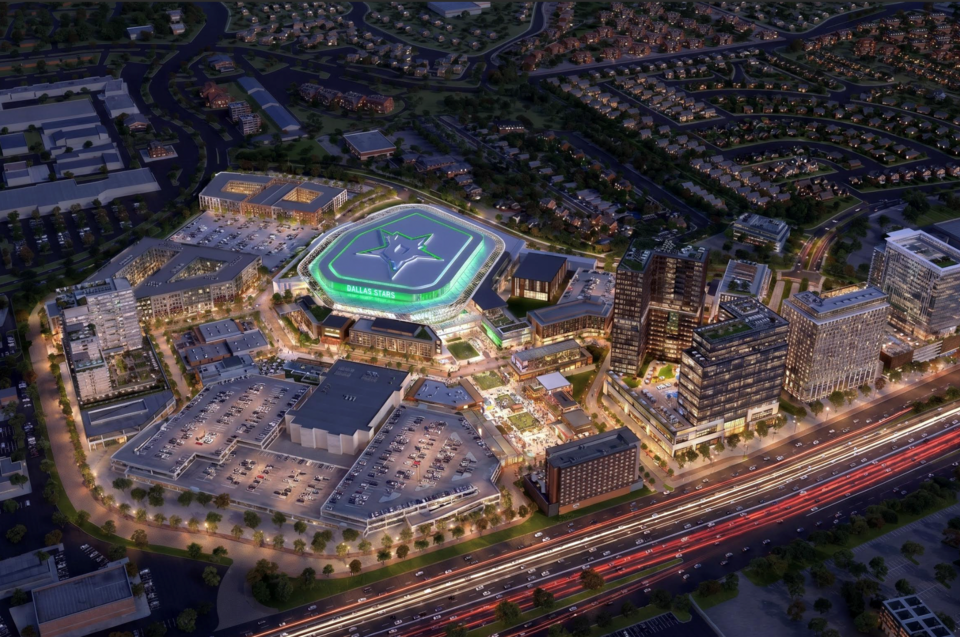
It's official enough to start paying attention: the Dallas Stars are planning to make Plano their new home. On June 8, 2026, the Plano City Council took a series of historic votes that cleared the runway for a roughly $1 billion arena and entertainment district on the site of the struggling Shops at Willow Bend mall — a project that will reshape west Plano for a generation.
For hockey fans, it's a seismic shift: the Stars leaving downtown Dallas after three decades at the American Airlines Center. For homeowners, investors, and anyone watching North Texas real estate, it's something bigger — the kind of catalytic development that moves property values, reshapes commutes, and turns a sleepy mall corner into one of the most valuable addresses in Collin County.
Here's everything we know so far, what's still up in the air, and why I'm watching this one closely (our OnDemand Realty office is, after all, right in the neighborhood).
The Headlines: What Just Happened
After roughly a year of quiet negotiations, the Stars announced on June 2 that they'd signed a non-binding Letter of Intent to build a new arena at The Shops at Willow Bend. Six days later, the Plano City Council made it real on their end with a unanimous series of approvals:
- Approved the Letter of Intent formalizing negotiations with the Stars
- Created a Tax Increment Reinvestment Zone (TIRZ) spanning 900+ acres around Willow Bend
- Approved roughly $15 million to help the current mall owners with demolition
- Committed about $700 million in public funding toward the roughly $1 billion project
- Authorized a future election that would let Plano voters weigh in on raising the hotel occupancy tax and adding taxes on car rentals and parking revenue within the district
Stars owner Tom Gaglardi called it "a once-in-a-lifetime opportunity," and set the target plainly: "making Plano our new home in 2031."
When Will It Actually Open? (Set Your Expectations to 2031)
Let's be clear about the timeline, because this is the part that gets oversimplified.
This is not a stadium opening next season. The Stars' lease at the American Airlines Center runs through 2031, and that's the target window for the new Plano arena to come online. The near-term milestone is demolition of the old Willow Bend mall, scheduled to begin in fall 2026, clearing the way for the new mixed-use development — branded "The Bend" — being advanced by Centennial along with Levin Holdings & Cawley Partners.
There are also hurdles left. The LOI is non-binding, and that voter tax election still has to happen. So while the momentum is real and the city is clearly committed, this is a multi-year build, not a ribbon-cutting around the corner.
For real estate, that long runway is the opportunity, not the drawback. The buyers who understand what a 2031 anchor does to surrounding values are the ones making moves in 2026 — long before the cranes are gone.
Where It's Going
The arena district will sit at the northwest corner of West Park Boulevard and the Dallas North Tollway in west Plano — the current Willow Bend site at 6121 W. Park Blvd, about a mile north of the President George Bush Turnpike.
| Detail | What We Know |
|---|---|
| Site | The Shops at Willow Bend, Park Blvd & Dallas North Tollway |
| Core redevelopment footprint | ~76–107 acres (within a 900+ acre TIRZ) |
| Arena size | Roughly 20,000 seats |
| Project cost | Exceeding $1 billion |
| Public funding | ~$700 million via the tax district |
| Developers | Centennial, Levin Holdings & Cawley Partners |
| Demolition begins | Fall 2026 |
| Target arena opening | 2031 |
It's worth appreciating the symbolism here. Willow Bend opened in 2001 as the last enclosed mall ever built in Texas, and it spent two decades struggling against Galleria Dallas, Stonebriar, and Legacy West. Anchors like Macy's, Dillard's, and Neiman Marcus have closed ahead of demolition. Turning that fading retail relic into a 20,000-seat NHL arena and year-round entertainment district is one of the most dramatic redevelopment stories the suburb has ever seen.
The Traffic Question: Plan on a Car-Centric Crowd
No honest look at this project skips traffic, and Plano residents raised exactly this concern at the council meeting.
Here's the reality: the site sits at the meeting point of two major arteries — the Dallas North Tollway and West Park Boulevard — with the President George Bush Turnpike a mile south and Preston Road close by. That's strong highway access, which the district will need, because public transit is limited. The nearest DART rail station, Parker Road Station, is about 8.2 miles away — meaning the overwhelming majority of fans for 40+ regular-season home games (plus concerts and events) will arrive by car.
What that means in practice:
- Event-day congestion on the Tollway and Park Boulevard before and after games is a near certainty, much like any major arena district.
- Infrastructure investment — road improvements, signal timing, and parking structures — will be a central part of the district's design, and part of what that public funding is meant to address.
- Surrounding neighborhoods will feel the spillover, which is both a quality-of-life consideration for current residents and a demand driver for housing within walking or short-drive distance.
For buyers, here's the nuance worth understanding: proximity to an arena is a double-edged sword. Walkable-but-not-on-top-of-it locations tend to capture the upside (amenities, dining, value appreciation) while minimizing the downside (event-night noise and traffic). Knowing which streets fall on which side of that line is exactly the kind of hyperlocal knowledge that pays off — and where having an agent who knows the neighborhood block by block matters.
The Money: What It Could Mean for Plano
Official, third-party economic-impact projections for this specific project haven't been published yet, so I'm not going to throw out a made-up number. But we can talk concretely about where the value comes from:
Direct investment. A project exceeding $1 billion in development cost is a massive injection of construction spending, jobs, and permanent employment into Plano's economy.
New tax streams. The district is built around generating revenue the city otherwise wouldn't have. The TIRZ captures future property-tax growth on land that's currently an underperforming mall. The proposed hotel occupancy, car rental, and parking taxes are designed to have visitors — not existing Plano residents' general fund — help pay for the public share.
Year-round activity. This isn't just 41 hockey nights. Modern arena districts are engineered as 365-day destinations: concerts, conventions, restaurants, retail, residential, and public gathering spaces. That's a steadier economic engine than a seasonal venue, and it's the model "The Bend" is being built on.
The halo effect on real estate. This is the part I care about most as a broker. Catalytic projects like this tend to lift surrounding property values, accelerate new residential and mixed-use construction, and raise the profile of the entire submarket. West Plano is already one of the most affluent, fastest-growing corridors in the country — Willow Bend literally sits in the "bull's eye" of it. Add a marquee NHL anchor, and the long-term trajectory for nearby home values is hard to bet against.
The honest counterpoint, which several residents voiced: publicly funded arenas have a mixed track record of delivering the returns they promise, and reasonable people debate whether the public share is worth it. That's a real conversation Plano voters will get to have. But from a pure real estate standpoint, the direction of travel for this corner is up.
OnDemand Realty: Right in the Neighborhood
Here's where this gets personal for us. OnDemand Realty has an office right next to where all of this is happening — which means when buyers and sellers ask me what the Stars' arena means for their home or their next move, I'm not answering from across the Metroplex. I'm answering from the neighborhood that's about to change the most.
That proximity matters. As The Bend takes shape over the next several years, the questions are going to come fast: Which neighborhoods will appreciate the most? When's the right time to buy in before prices move? If I own nearby, should I hold or sell? What's the noise-and-traffic tradeoff street by street?
Those aren't questions you want answered by a national portal estimate. They're questions for someone who's watching the dirt move in real time, right down the road.
The Bottom Line
The Dallas Stars choosing Plano is a landmark moment for the city and for North Texas. A $1 billion arena district, rising from the bones of a dying mall, anchored by an NHL franchise, in the heart of one of America's most dynamic suburban markets — that's the kind of thing that defines a decade of growth.
It won't open until around 2031, and there's process still ahead. But smart real estate decisions get made early, when the opportunity is visible but the prices haven't fully caught up. If you own near Willow Bend, are thinking about buying into west Plano, or just want to understand how this reshapes the map, let's talk. I'm right next door, and I'd love to help you navigate it.
Categories
Recent Posts