Living in DeSoto, TX: The Honest Pros and Cons of the Southern Sector's Established Standard
Living in DeSoto, TX: The Honest Pros and Cons of the Southern Sector's Established Standard
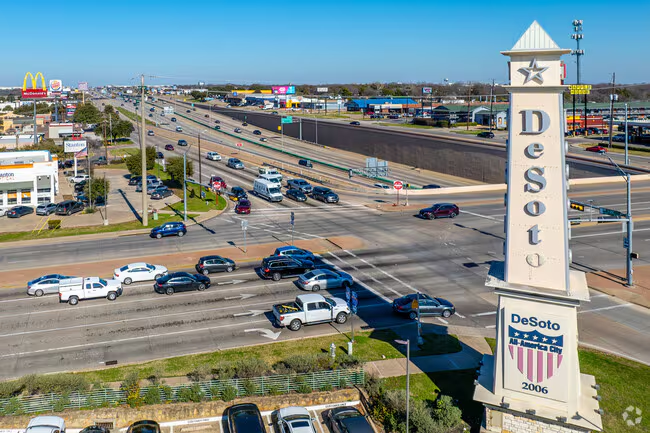
DeSoto is the southern sector's established standard-bearer — a 56,000-resident Dallas County suburb that built out decades before the current growth wave, leaving it with something its booming neighbors can't buy: mature neighborhoods of brick homes on genuinely large lots, grown trees, and a settled, proudly middle-class-and-up community identity. Fifteen miles from downtown Dallas via I-35E, DeSoto has long been one of the metro's most prominent predominantly Black suburbs, with the civic institutions, championship athletics tradition, and homeowner pride to show for it.
It also carries southern-sector market realities that deserve straight talk. Here's the honest breakdown.
Quick Snapshot
- County: Dallas
- Population: Roughly 56,000
- Typical price range: Approximately $275,000–$425,000 across most of the market, with executive sections (larger 1990s–2000s customs) reaching $450,000–$650,000+ — consistently more house and lot per dollar than nearly anywhere in Dallas County
- School district: DeSoto ISD, with city edges touching Duncanville and Cedar Hill ISDs and notable charter presence
- Location: I-35E corridor, roughly 15 miles south of downtown Dallas; 20–25 minutes to downtown, similar to the I-20 employment belt
- Vibe: Established, spacious, community-proud, quietly affluent in its executive sections
The Pros
1. Square footage and lot size the north forgot
DeSoto's dominant 1980s–2000s construction era built big: 2,500–4,000+ square-foot brick homes on quarter-acre-plus lots, three-car garages, real backyards. Comparable physical product in the northern corridor costs $200,000–$400,000 more. For buyers measuring in square feet and fence lines, DeSoto delivers the best big-house math in Dallas County.
2. Fifteen miles from downtown, no tolls required
I-35E runs straight downtown in 20–25 minutes; I-20 puts the southern employment belt (distribution, healthcare, the growing inland-port logistics cluster) within 15; and Cedar Hill's retail, the Methodist and Baylor southern campuses, and UNT Dallas are all minutes out. DeSoto's centrality is chronically underpriced by buyers who never look south.
3. A genuinely established community fabric
Decades of stable homeownership built real institutions: active civic organizations, established churches, strong youth sports, and a city government that maintains parks (Grimes Park's complex, the Windmill Hill Nature Preserve trails) and services with pride. This is a community, not a collection of recent arrivals — and it shows in the block-level upkeep.
4. Championship athletic tradition
DeSoto High's athletics are regionally legendary — state-championship football, nationally ranked track programs that regularly send athletes to D1 programs and beyond. Friday nights at Eagle Stadium are a civic institution, and the athletic pipeline is a genuine point of community identity and student opportunity.
5. Executive housing at half price
The Thorntree Country Club area and DeSoto's custom sections offer 3,500–5,000-square-foot executive homes — many on the golf course — at prices that would embarrass equivalent Plano or Southlake product. For established professionals who want the big house without the northern premium, this niche is one of the metro's best-kept value stories.
6. Improving trajectory with the southern sector's rise
The southern Dallas County growth story — inland port logistics jobs, UNT Dallas' expansion, new retail investment along I-35E and I-20 — is lifting the whole sector, and established, well-kept DeSoto is positioned to benefit as buyers priced out of the north finally look south.
The Cons
1. School ratings require the same honesty we give everywhere
DeSoto ISD has invested heavily in turnaround work after a difficult stretch — with improving state accountability marks and genuine bright spots in athletics-linked opportunity and specific programs — but campus-level ratings across the district currently sit below the 7+ threshold we'd need to print numbers responsibly, and many resident families run deliberate strategies: charters, transfers, private options, or the neighboring districts. Shop the specific campus with current data, tour it, and build your school plan before your house plan — the same counsel we give in Arlington and Dallas applies here without apology.
2. Retail and dining lag the rooftops
DeSoto's own sit-down dining and retail bench runs thin for a city its size — Hampton Road and Belt Line corridors cover basics, while destination dining means Cedar Hill's Hillside Village cluster, Duncanville, or Dallas. New investment is arriving; today's resident still drives for the good dinner.
3. Aging stock entering major-system decades
The 1980s–90s core is 30–45 years old: roofs on second and third cycles (insurance keys on this — get dates), original HVAC eras, cast iron drains in the earliest sections, and clay-soil foundation vigilance throughout. The big-house math only works with honest inspection budgets attached; renovated homes price the difference for you.
4. Value appreciation has historically trailed the north
The southern sector's structural discount cuts both ways: DeSoto homes cost less and have historically appreciated more slowly than northern-corridor equivalents. The sector's current trajectory may be changing that story — but buyers should underwrite DeSoto on lifestyle-per-dollar today, treating outperformance as upside rather than assumption.
5. I-35E's southern crawl
The corridor's downtown approach congests hard at peak, and the years of construction phases haven't helped predictability. The 20-minute off-peak run can stretch well past that at rush hour — standard big-corridor reality, worth test-driving.
6. Block-level variation on the edges
DeSoto's core neighborhoods hold beautifully; some edges and older pockets show more wear, and adjacent-corridor conditions vary. As across the southern sector: evaluate the specific block and its trajectory, not the citywide summary in either direction.
Cost of Ownership: The Big-House Math, Audited
Model a $375,000 DeSoto home — likely 3,000+ square feet on a real lot, which is the whole point. The tax stack — city, Dallas County, DeSoto ISD, college and hospital districts — lands in the mid-2% range before exemptions, with no MUD/PID layers in the established fabric: a legible bill that exemption management meaningfully trims. Homestead files with the Dallas Central Appraisal District immediately; the annual protest habit pays; over-65 ceilings make DeSoto's large single-stories a strong retirement play.
The age-of-asset budget is the honest counterweight: a 1992 home's roof date drives the insurance quote (hail belt rules apply), HVAC replacement on 3,500 square feet is a $12,000–$20,000 event when it comes, and sewer scopes on pre-1990 sections earn their fee. Price the systems into every offer. The offsets: no toll dependence for most commutes, big-lot living without amenity-fee HOAs across most neighborhoods (Thorntree-area sections vary — review documents), and a cost-of-living baseline that lets the same income live visibly larger than it would twenty miles north.
Where to Eat: 5 Favorites In and Around DeSoto
The honest framing: DeSoto's own destination-dining bench is short, but the best-southern-sector cluster sits minutes away:
- Vila Brazil (Cedar Hill) — Full rodizio Brazilian steakhouse with an "Exceptional" 4.8 rating — the area's celebration-dinner answer, ten minutes out.
- Soul Shack Bar and Grill (Cedar Hill) — Chicago-born soul food, nightly live music, and the famous soul rolls.
- Hillside Social (Cedar Hill) — Contemporary Southern cuisine at Hillside Village for the upscale night.
- Babe's Chicken Dinner House (Cedar Hill's historic downtown) — The family-style fried chicken institution minutes west.
- The Finch (Grand Prairie, EpicCentral) — The well-rated American kitchen at the EpicCentral entertainment district, fifteen minutes north.
Golf in DeSoto
Thorntree Country Club is DeSoto's own — the long-established private club whose championship course threads the city's executive Thorntree neighborhoods, offering member golf and course-lot living at southern-sector prices. Grand Prairie's standout Tangle Ridge and Dallas' historic municipal courses (Cedar Crest, Stevens Park) sit within 20 minutes for the public rotation.
School Ratings Worth Knowing
Per our standing rule — we only print verified 7+ GreatSchools numbers — we can't responsibly quote campus ratings for DeSoto ISD as of this writing: current campus scores sit below that threshold while the district works through a genuine improvement effort with better state accountability marks than its low point. What that means practically: pull live campus ratings at GreatSchools' DeSoto page, tour the zoned schools and ask about the specific programs (the athletic-academic pipeline is real opportunity for the right students), and — like many DeSoto families — evaluate the charter, transfer, and neighboring-district options as part of a deliberate plan. Buying the house without the school plan is the one DeSoto mistake we see repeated.
Frequently Asked Questions About Living in DeSoto
How much house does the DeSoto premium-to-value gap really buy? Concretely: the 3,000–4,000-square-foot brick home on a quarter-acre that trades in DeSoto's $300,000s–$400,000s would command $600,000–$800,000+ in the equivalent northern-corridor suburb. That spread — not any single feature — is DeSoto's core proposition.
What school options do DeSoto families actually use? A deliberate mix: DeSoto ISD campuses (with the athletic-academic pipeline a genuine draw), area charters, transfer options, private schools, and the neighboring districts' edges. The successful pattern is choosing the plan before the house — the same counsel we give in every campus-variance market.
What's the Thorntree area? DeSoto's executive district: the private Thorntree Country Club's championship course threaded by 3,500–5,000-square-foot custom homes from the 1980s–2000s — course-lot living at prices the northern club corridors abandoned decades ago.
How's the commute downtown? About 20–25 minutes via I-35E off-peak, stretching at rush hour like every corridor — with no tolls required, which quietly saves thousands annually versus toll-dependent suburbs. The I-20 southern employment belt sits even closer.
Is the southern sector really rising? The investment is measurable: inland-port logistics growth, UNT Dallas expansion, new retail along I-35E and I-20, and buyer attention finally turning south as northern pricing excludes more households. Established, well-maintained DeSoto is positioned squarely in that path — trajectory as upside, not assumption.
What should I inspect hardest in a DeSoto home? The age-of-asset trio: roof date (drives insurance in the hail belt), HVAC era on big square footage, and sewer/foundation review on pre-1990 sections. The big-house math holds — when the systems budget rides along.
Helpful Links
- City of DeSoto — city services, parks, and events
- DeSoto ISD — boundaries, programs, and enrollment
- GreatSchools: DeSoto, TX — current campus ratings
- Thorntree Country Club — membership and course info
- Dallas Central Appraisal District — exemptions and protests
- OnDemand Realty — DeSoto listings from established neighborhoods to Thorntree customs
Who DeSoto Fits Best
- Buyers maximizing house and lot per dollar inside Dallas County
- Established professionals targeting Thorntree-tier executive homes at half northern prices
- Downtown and southern-belt commuters wanting a toll-free 20-minute radius
- Families with a deliberate school strategy who value the community's institutions
- Long-hold owners positioned for the southern sector's rising trajectory
Who Should Look Elsewhere
- Families shopping solely on public district ratings without a campus-level plan
- Buyers needing destination retail and dining inside their own city limits
- Anyone unwilling to budget for 30-40-year-old home systems
- Short-hold buyers requiring northern-corridor appreciation velocity
The Bottom Line
DeSoto sells the thing the northern corridor priced away: room. Big brick homes, big lots, grown trees, and an established community that maintains what it built — twenty minutes from downtown, no tolls attached. The homework is real and specific — school plan first, roof dates always, block by block on the edges — and buyers who do it get more physical house and more settled community per dollar than almost anywhere in Dallas County. The southern sector's moment is building; DeSoto's been ready for it.
Categories
Recent Posts